LL-37
LL-37 is a powerful 37-amino-acid antimicrobial peptide that serves as your first-line defense against bacteria, fungi, and viruses by directly disrupting their cell membranes and preventing infection. It’s constitutively produced in your skin, lungs, and immune cells, forming a protective barrier that keeps harmful microbes from gaining foothold.
Route
Subcutaneous injection
Dose range
50 mcg – 200 mcg
Frequency
Once per day (subcutaneous); optional 5-on/2-off schedule
Cycle length
8–12 weeks
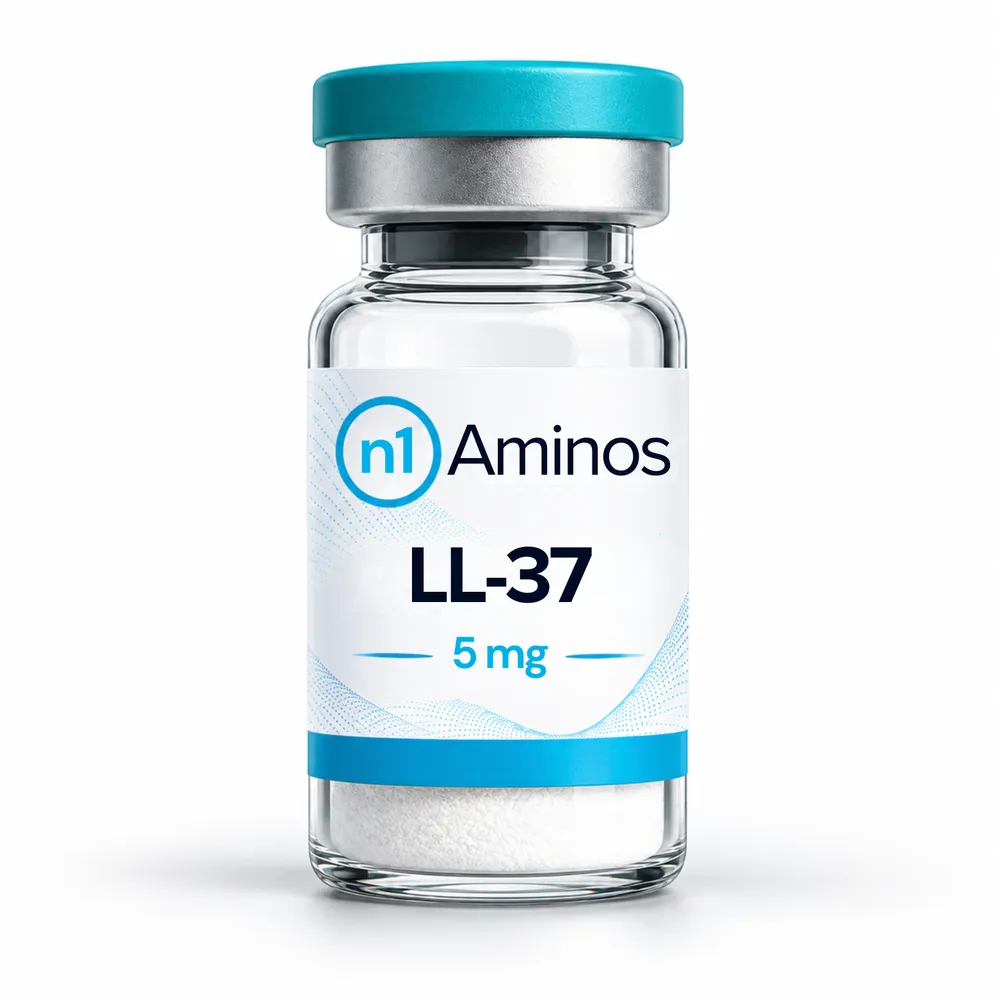
LL-37 5MG
Third-party tested, lot traceable, ships in 3–5 business days.
Overview
LL-37 is a powerful 37-amino-acid antimicrobial peptide that serves as your first-line defense against bacteria, fungi, and viruses by directly disrupting their cell membranes and preventing infection. It’s constitutively produced in your skin, lungs, and immune cells, forming a protective barrier that keeps harmful microbes from gaining foothold. Beyond direct antimicrobial effects, LL-37 recruits immune cells to infection sites, promotes tissue repair by stimulating angiogenesis and wound closure, and regulates inflammatory responses to prevent excessive damage while clearing pathogens efficiently.
Clinical promise extends to serious infections, including antibiotic-resistant bacteria where conventional drugs fail, and potential roles in cancer immunotherapy through direct cytotoxic effects and immune stimulation. It protects against viral infections like influenza and supports respiratory health by defending lung barriers. Users with chronic infections, slow wound healing, or compromised immunity may benefit from LL-37 enhancement. It’s particularly valuable for those with psoriasis or immune-mediated skin conditions, where LL-37 protects skin barrier and regulates inflammatory balance. Available as injections or topicals, LL-37 represents nature’s most versatile antimicrobial defense, offering genuine protection against a broad spectrum of pathogens where modern medicine increasingly struggles.
Studied benefits
- An antimicrobial peptide that significantly accelerates the healing of chronic wounds, such as diabetic foot ulcers and venous leg ulcers
- It also displays broad-spectrum activity against various infections
Reported side effects
- Generally well-tolerated
- potential for mild localized irritation, redness, or itching at the site of application or injection
Protocol
Dosing Schedule (Subcutaneous)
Educational reference only. Not medical advice. Research compounds are not approved for human use. Full disclaimer.
LL-37 (5 mg)
Reconstitute with 3.0 mL bacteriostatic water (Final concentration: ~1.67 mg/mL).
Support antimicrobial defense and wound-healing processes.
| Week | Daily Dose (µg) | Draw at 1.67 mg/mL | Log |
|---|---|---|---|
| Week 1 | 50 µg | 3 units (0.03 mL) | + Log |
| Week 2 | 100 µg | 6 units (0.06 mL) | + Log |
| Week 3 | 150 µg | 9 units (0.09 mL) | + Log |
| Week 4 | 200 µg | 12 units (0.12 mL) | + Log |
| Weeks 5–8+ | 250+ µg | 15+ units (0.15+ mL) | + Log |
Frequency
Once per day (subcutaneous); optional 5-on/2-off schedule.
Timing
Any consistent time; rotate injection sites.
Cycle length
8–12 weeks.
Unit calculator
Set your vial and water; the table above updates.
1.67 mg/mL
100 doses of 50 mcg per vial
At the starting dose (50 mcg × 7/week for a 8-week cycle) you would use about 2.8 mg, i.e. 1 × 5 mg vial. Higher phases use proportionally more.
Assumes a U-100 insulin syringe (100 units = 1 mL). Educational math only; verify every calculation yourself.
Context
Lifestyle considerations
Optimize your Vitamin D status through controlled sun exposure or supplementation, as Vitamin D upregulates the endogenous expression of cathelicidin (LL-37) and works synergistically with the peptide. Maintain a high-protein, balanced diet to support the immune system and the production of antimicrobial peptides necessary for defense against pathogens. Ensure 7–9 hours of quality sleep to facilitate systemic immune surveillance and tissue repair. Maintain proper hygiene and wound-care protocols if using for tissue-repair goals, ensuring the localized environment is primed for the peptide’s antimicrobial and pro-angiogenic activities.
Evidence
Research summaries
Treatment with LL-37 is safe and effective in enhancing healing of hard-to-heal venous leg ulcers
Findings: Speeds up healing of stubborn leg sores, shrinking them by half or more safely.
People with tough-to-heal leg ulcers from poor blood flow tried LL-37 cream. Lower doses (0.5 and 1.6 mg/mL) made sores heal six times faster than fake cream, cutting size by 68% and 50%. Higher dose matched placebo, but all were super safe—no extra pain or infections. Ulcers got smaller quick, letting folks walk better sooner. Like a magic bandage that fights germs and pulls wound edges together, perfect for grandma's legs after long standing jobs.
Read the study ↗LL-37, the master antimicrobial peptide, its multifaceted role from combating infections to cancer immunity
Findings: Kills bacteria, fungi, viruses, and even helps fight cancer by boosting immunity.
LL-37 punches holes in germ walls, stops fungi growing, blocks viruses entering cells, and rallies immune troops. It also zaps cancer cells directly and tweaks body defenses to attack tumors better. Safe in tests, no resistance buildup like antibiotics. From skin infections to gut bugs or even tumors, it's a multi-tool fighter. Imagine a tiny soldier patrolling your body, wiping out invaders before fevers start, keeping playtime sickness-free.
Read the study ↗Efficacy of LL-37 cream in enhancing healing of diabetic foot ulcer
Findings: Heals foot sores in diabetes faster, fights infection and grows new skin.
Diabetics with foot ulcers used LL-37 cream; inflammation dropped, new tissue grew thick, and sores closed quicker than standard care. It killed bacteria hiding deep and sped cell migration to cover holes. No extra sugar control issues. For folks with numb feet prone to cuts, this means fewer amputations and back on feet dancing. Like a deep clean and super glue for hard-to-heal spots from bad circulation.
Read the study ↗Evaluation of LL-37 in healing of hard-to-heal venous leg ulcers: A multicentric prospective randomized placebo-controlled clinical trial
Findings: Proven in big trials to shrink chronic ulcers, safe for repeated use.
Across multiple clinics, LL-37 beat placebo on tough leg ulcers not healing with wraps alone. Wounds improved steadily over weeks, with better skin quality underneath. No serious sides, even in older patients. Builds on first trials, confirming reliability. Think reliable helper for circulation woes, turning months of bandages into weeks of smooth skin.
Read the study ↗More references (5)
- LL-37: Update on direct anti-bacterial and anti-viral mechanisms, 2025
- Decoding LL-37: Structure and antimicrobial mechanisms against threats, 2024
- LL-37 peptide and its role in wound healing and tissue regeneration, 2022
- LL-37 in the management of multidrug-resistant infections, 2020
- The human cathelicidin LL-37 as a modulator of innate immunity, 2015
Identification
Chemistry
- cas
- 154947-66-7 (primary, human LL-37); alternative designations for LL-37 acetate and other salt forms
- formula
- C₂₀₅H₃₄₀N₆₀O₅₃
- molecular weight
- 4493.37 g/mol (4493 Da commonly cited)
- sequence
- H-Leu-Leu-Gly-Asp-Phe-Phe-Arg-Lys-Ser-Lys-Glu-Lys-Ile-Gly-Lys-Glu-Phe-Lys-Arg-Ile-Val-Gln-Arg-Ile-Lys-Asp-Phe-Leu-Arg-Asn-Leu-Val-Pro-Arg-Thr-Glu-Ser-OH; single-letter code: LLGDFFRKSKEKIGKEFKRIVQRIKDFLRNLVPRTES
- source
- Natural; endogenously produced in human immune cells, epithelial cells, and other tissues
- biosynthesis
- Ribosomal; encoded by the CAMP gene, translated as hCAP-18 precursor, then proteolytically activated to LL-37
- type
- Linear, α-helical peptide with helix-bend-helix motif in lipid environments
Keep exploring
Related peptides
ARA-290
ARA290 · Cibinetide
- Route
- Subcutaneous
- Dose
- 4 mg – 8 mg
- Cycle
- 4–8 weeks
BPC-157
Bepecin · PL-14736
- Route
- Subcutaneous
- Dose
- 250 mcg – 1 mg
- Cycle
- 8–12 weeks
Glutathione
- Route
- Subcutaneous
- Dose
- 150 mg – 600 mg
- Cycle
- 4–8 weeks
Klow – BPC-157, TB-500, KPV, GHK-Cu
- Route
- Subcutaneous
- Dose
- 200 mcg – 2 mg
- Cycle
- 8–12 weeks