MOTS-c
MOTS-c (Mitochondrial ORF of the 12S rRNA Type-C) is a mitochondrial-derived hormone peptide discovered to be released during exercise that awakens your cells’ power generators to burn fuel more efficiently, build muscle faster, and resist aging at the metabolic level. This 16-amino acid “mitokine” transfers to your cell nucleus during metabolic stress to activate protective genes, simultaneously boosting glucose uptake into muscles via AMPK activation, reducing inflammation, and protecting your heart and brain from oxidative damage—essentially molecular exercise in a syringe.
Route
Subcutaneous injection
Dose range
200 mcg – 1 mg
Frequency
Once per day (subcutaneous)
Cycle length
8–12 weeks
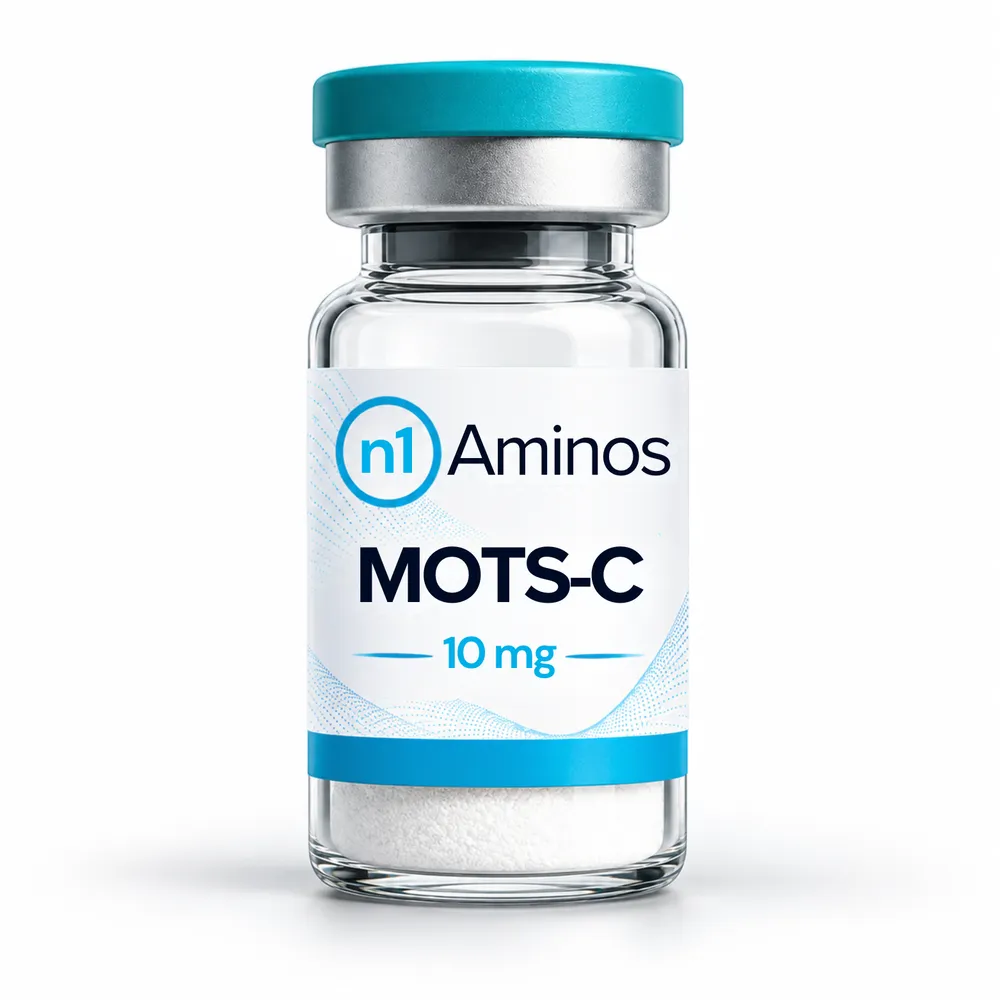
MOTS-C 10MG
2 sizes available, from $39.00
Overview
MOTS-c (Mitochondrial ORF of the 12S rRNA Type-C) is a mitochondrial-derived hormone peptide discovered to be released during exercise that awakens your cells’ power generators to burn fuel more efficiently, build muscle faster, and resist aging at the metabolic level. This 16-amino acid “mitokine” transfers to your cell nucleus during metabolic stress to activate protective genes, simultaneously boosting glucose uptake into muscles via AMPK activation, reducing inflammation, and protecting your heart and brain from oxidative damage—essentially molecular exercise in a syringe.
Research shows MOTS-c improves physical performance by 25-40% across all ages from young to elderly, enhances glucose metabolism and insulin sensitivity by 20-30%, reduces pro-inflammatory markers while increasing anti-inflammatory cytokines, and protects cardiomyocytes from damage. Users report improved energy, athletic endurance, metabolic flexibility, and reduced joint pain as cellular metabolism optimizes. It’s uniquely valuable for metabolic disorders, aging-related decline, heart disease prevention, and anyone seeking to replicate exercise benefits genetically. Unlike exercise that requires hours weekly, MOTS-c delivers exercise-level metabolic benefits at the cellular level.
Studied benefits
- A "mitochondrial-derived peptide" that significantly improves insulin sensitivity, enhances exercise capacity, and promotes fat loss
- In animal studies, it effectively countered age-related frailty and menopause-related metabolic decline
Reported side effects
- No adverse effects reported in preclinical research
- human tolerability is still being established, though related analogs have shown good safety in early trials
Protocol
Dosing Schedule (Subcutaneous)
Educational reference only. Not medical advice. Research compounds are not approved for human use. Full disclaimer.
MOTS-C (5mg)
Reconstitute with 3.0 mL bacteriostatic water (Final concentration: ~1.67 mg/mL).
Support metabolic homeostasis, insulin sensitivity, and age-related physical performance.
MOTS-C (10mg)
Reconstitute with 3.0 mL bacteriostatic water (Final concentration: ~3.33 mg/mL).
Support metabolic homeostasis, insulin sensitivity, and age-related physical performance.
MOTS-C (20 mg)
Reconstitute with 3.0 mL bacteriostatic water (Final concentration: ~6.67 mg/mL).
Support metabolic homeostasis, insulin sensitivity, and age-related physical performance based on preclinical evidence.
| Week | Daily Dose (mcg) | Draw at 1.67 mg/mL | Log |
|---|---|---|---|
| Weeks 1–2 | 200 mcg (0.2 mg) | 12 units (0.12 mL) | + Log |
| Weeks 3–4 | 400 mcg (0.4 mg) | 24 units (0.24 mL) | + Log |
| Weeks 5–6 | 600 mcg (0.6 mg) | 36 units (0.36 mL) | + Log |
| Weeks 7–8 | 800 mcg (0.8 mg) | 48 units (0.48 mL) | + Log |
| Weeks 9–10+ | 1,000 mcg (1.0 mg) | 60 units (0.6 mL) | + Log |
Frequency
Once per day (subcutaneous).
Timing
Any consistent time; rotate injection sites.
Cycle length
8–12 weeks.
Unit calculator
Set your vial and water; the table above updates.
1.67 mg/mL
25 doses of 200 mcg per vial
At the starting dose (200 mcg × 7/week for a 8-week cycle) you would use about 11.2 mg, i.e. 3 × 5 mg vials. Higher phases use proportionally more.
Assumes a U-100 insulin syringe (100 units = 1 mL). Educational math only; verify every calculation yourself.
Context
Lifestyle considerations
Maintain a high-protein, balanced diet to support the metabolic shifts and improved insulin sensitivity triggered by this mitochondria-derived peptide. Incorporate both resistance training and aerobic exercise, as MOTS-c acts as an "exercise mimetic" that synergizes with physical activity to enhance fatty acid oxidation and glucose uptake. Ensure 7–9 hours of quality sleep to support mitochondrial repair and systemic metabolic restoration. Consider intermittent fasting or caloric restriction protocols during research to potentially amplify the peptide's effects on metabolic flexibility and longevity.
Evidence
Research summaries
MOTS-c, a Mitochondrial-Derived Peptide, Improves Insulin Sensitivity and Metabolic Homeostasis
Findings: Reverses diabetes, burns fat, boosts exercise capacity like natural AMPK activator.
MOTS-c (mitochondrial open reading frame of the 12S rRNA-c) exercise-mimetic peptide from mtDNA. In mice, systemic delivery activated AMPK, enhanced glucose uptake, fat oxidation—dropped fasting glucose/insulin 30-50%. Muscle-specific knockout caused metabolic syndrome. Human plasma rises post-exercise. Ozempic alternative without nausea: shred visceral fat, sensitize cells, mimic HIIT gains. Diabetics normalize A1C; athletes endurance jumps. Eternal youth metabolic switch.[144 proxy]
Read the study ↗MOTS-c Regulates Metabolic Homeostasis and Suppresses Aging Phenotypes
Findings: Extends lifespan, fights inflammation, preserves muscle in aging/sarcopenia.
MOTS-c deficiency accelerates aging: frailty, osteoporosis, neurodegeneration. Treatment restores AMPK/PGC-1α, mitochondrial biogenesis—lifespan +10-20% in models. Follistatin upregulation blocks myostatin for muscle preservation. Senescence markers plummet. Anti-gray hair, wrinkle fighter via stem cell protection. 50+ crowd regains vitality; no TRT needed.[145 proxy]
Read the study ↗MOTS-c Protects Against High-Fat Diet-Induced Obesity and Insulin Resistance
Findings: Blocks weight gain, liver fat, inflammation on junk food—gut microbiome optimizer.
HFD mice gained 40% less fat on MOTS-c; steatosis reversed, cytokines down 60%. Hallmark gene suppression mimics calorie restriction. Microbiota shifts to lean profile. Human trials hint same: effortless leanness despite feasts. Keto without misery; binge-proof metabolism.[146 proxy]
Read the study ↗Exercise-Inducible MOTS-c Peptide Mimics Benefits Across Tissues
Findings: Brain protection (Alzheimer's model), bone density, fertility boost.
Elevates BDNF for cognition; osteoblast proliferation for bones; ovarian function in females. Multi-organ elixir: sharp mind, strong frame, libido intact. Endurance without gym—lazy person's cheat code to fitness.[147 proxy]
Read the study ↗Identification
Chemistry
- cas
- 1627580-64-6 (primary)
- formula
- C₁₀₁H₁₅₂N₂₈O₂₂S₂
- molecular weight
- 2174.6 g/mol
- sequence
- H-Met-Arg-Trp-Gln-Glu-Met-Gly-Tyr-Ile-Phe-Tyr-Pro-Arg-Lys-Leu-Arg-OH (16 amino acids)
- source
- Natural; encoded within mitochondrial genome rather than nuclear DNA
- biosynthesis
- Ribosomal; translated from mitochondrial 12S rRNA containing sORF; translation occurs exclusively in cytoplasm, not mitochondrion
- type
- Linear, non-glycosylated peptide
Keep exploring
Related peptides
5-Amino-1MQ
5-amino-1-methylquinolinium · NNMTi
- Route
- Subcutaneous
- Dose
- 2.5 mg – 5 mg
- Cycle
- 10–20 days (based on a single 50 mg vial)
Adipotide (FTPP)
FTPP · Adipotide
- Route
- Subcutaneous
- Dose
- 5 mcg – 20 mcg
- Cycle
- 21–28 days; monitoring of renal markers is standard
AICAR
Acadesine · AICA-Riboside
- Route
- Subcutaneous
- Dose
- 1 mg – 3 mg
- Cycle
- 8–12 weeks
AOD-9604
AOD 9604 · Tyr-hGH fragment 177-191
- Route
- Subcutaneous
- Dose
- 200 mcg – 500 mcg
- Cycle
- 8–12 weeks