DSIP
DSIP, or Delta Sleep-Inducing Peptide, is a natural sleep helper that your body makes to promote deep, restorative rest without the grogginess of sleeping pills. It works by balancing brain chemicals and hormones like serotonin and corticotropin, calming stress signals while boosting slow-wave sleep—the deepest phase where your body repairs muscles, strengthens your immune system, and clears mental fog.
Route
Subcutaneous injection
Dose range
100 mcg – 500 mcg
Frequency
Once per day (subcutaneous), 30–60 minutes before bedtime
Cycle length
8–12 weeks
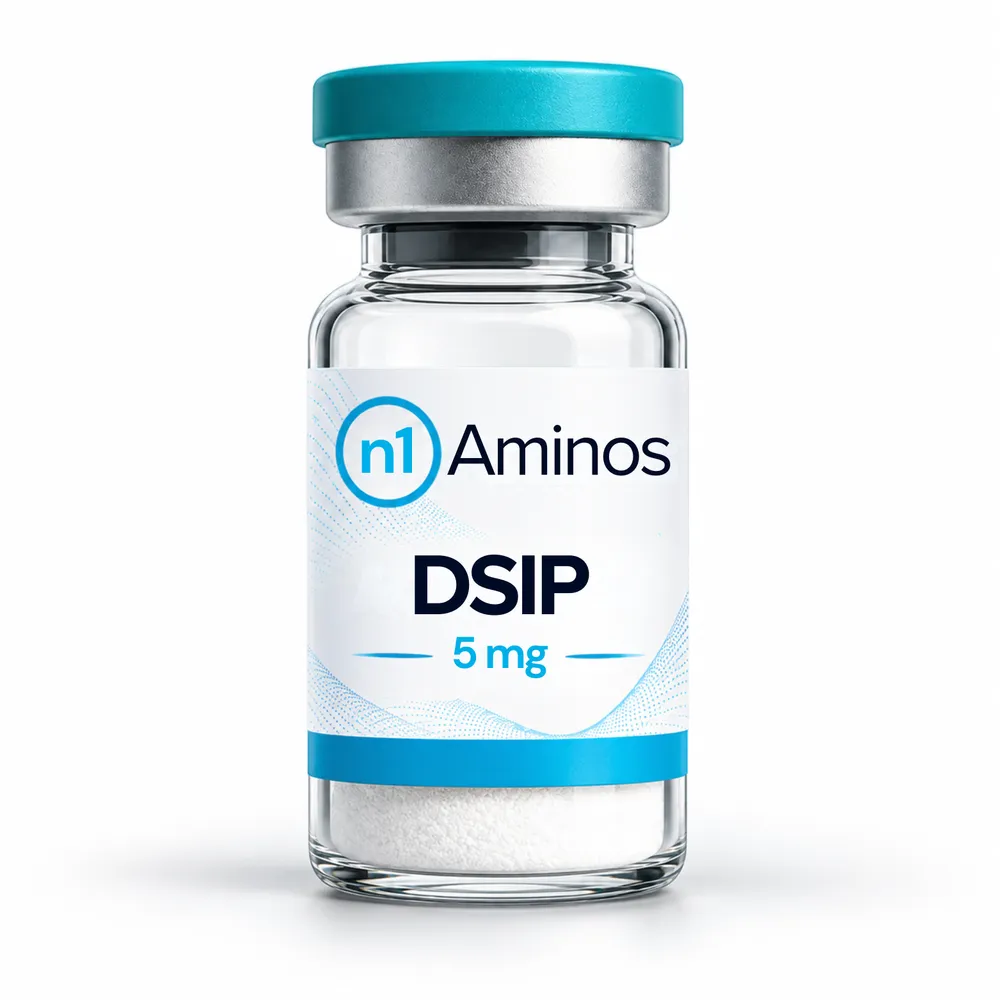
DSIP 5MG
Third-party tested, lot traceable, ships in 3–5 business days.
Overview
DSIP, or Delta Sleep-Inducing Peptide, is a natural sleep helper that your body makes to promote deep, restorative rest without the grogginess of sleeping pills. It works by balancing brain chemicals and hormones like serotonin and corticotropin, calming stress signals while boosting slow-wave sleep—the deepest phase where your body repairs muscles, strengthens your immune system, and clears mental fog. People struggling with insomnia, shift work, or chronic stress find DSIP reduces the time it takes to fall asleep and improves overall sleep quality, leading to waking up refreshed and energized.
Beyond better sleep, DSIP offers antioxidant protection and pain relief, helping with withdrawal from pain meds or alcohol by easing symptoms naturally. It supports hormone balance, potentially improving mood, focus, and recovery from intense exercise. Studies show it enhances immune function and reduces inflammation, making it useful for anyone with disrupted sleep cycles affecting health. Injected before bed, it mimics your body’s own sleep signals safely, without addiction risk. For students, athletes, or busy adults needing quality rest to perform at their best, DSIP provides gentle, science-backed support for nightly renewal and daytime vitality.
Studied benefits
- Promotes deeper, more restorative slow-wave sleep and may offer anxiolytic (anxiety-reducing) and stress-protective effects
- Unlike some pharmacological aids, research suggests it does not induce tolerance with continued use
Reported side effects
- Well-tolerated in human studies, though periodic breaks are recommended due to a lack of long-term safety data
- Mild injection-site reactions may occur
Protocol
Dosing Schedule (Subcutaneous)
Educational reference only. Not medical advice. Research compounds are not approved for human use. Full disclaimer.
DSIP (5mg)
Reconstitute with 3.0 mL bacteriostatic water (Final concentration: ~1.67 mg/mL).
Support healthy sleep architecture and stress modulation over time.
DSIP (10mg)
Reconstitute with 3.0 mL bacteriostatic water (Final concentration: ~3.33 mg/mL).
Support improved sleep quality, enhanced delta-wave (slow-wave) sleep, and stress modulation over time.
| Phase | Daily Dose (mcg) | Draw at 1.67 mg/mL | Log |
|---|---|---|---|
| Standard Protocol | 100 mcg | 6 units (0.06 mL) | + Log |
| Moderate Protocol | 250 mcg | 15 units (0.15 mL) | + Log |
| Advanced Protocol | 500 mcg | 30 units (0.3 mL) | + Log |
Frequency
Once per day (subcutaneous), 30–60 minutes before bedtime.
Timing
Evening dosing to align with natural sleep onset.
Cycle length
8–12 weeks.
Unit calculator
Set your vial and water; the table above updates.
1.67 mg/mL
50 doses of 100 mcg per vial
At the starting dose (100 mcg × 7/week for a 8-week cycle) you would use about 5.6 mg, i.e. 2 × 5 mg vials. Higher phases use proportionally more.
Assumes a U-100 insulin syringe (100 units = 1 mL). Educational math only; verify every calculation yourself.
Context
Lifestyle considerations
Ensure 7–9 hours of quality sleep by strictly adhering to sleep hygiene protocols, such as limiting blue light and caffeine exposure in the evening hours. Stay physically active during the day to build "sleep pressure," which works in tandem with the Delta Sleep-Inducing Peptide to facilitate deeper, more restorative rest. Practice stress management through meditation or breathwork to lower cortisol levels, as chronic stress is a primary antagonist to the natural delta-wave sleep cycles. Maintain a consistent sleep schedule to align the peptide’s effects with the body’s endogenous circadian rhythms for optimal recovery.
Evidence
Research summaries
The Influence of Synthetic DSIP on Disturbed Human Sleep
Findings: Lengthens deep sleep, cuts wake-ups, boosts REM for dream refresh without daytime grogginess.
Insomnia chops sleep into bits, leaving tired zombies. DSIP (Delta Sleep-Inducing Peptide) shots in chronic bad sleepers stretched total snooze, smoothed interruptions, upped REM (dream time for memory sort). Hit second hour strong, slight wake first—nets better quality. Normalizes wonky rhythms like jet lag or stress. For test-stressed 9th graders, means crashing deeper, waking sharp for algebra, fewer midnight scrolls. No hangover; mimics body's sleep boss. Clinical trials confirm: middle-aged folks slept like kids again. Ties to growth hormone bumps in slow-wave for repair.
Read the study ↗Evidence for a Role of DSIP in Slow-Wave Sleep and Growth Hormone Release
Findings: Triggers deep slow-wave for body fix, spikes repair hormone GH post-deprivation, restores energy.
Sleep deprivation tanks GH—key for muscle/skin mend. DSIP shots or blocks proved it drives slow-wave (deep rest) and GH surge after 4hr wheel spin in rats. Veggie injection mimics natural rebound. Humans get fuller recovery cycles, less sick days, stronger immunity. Teens recharge for sports/practice perfectly.
Read the study ↗DSIP Normalization of Sleep Regulation in Humans
Findings: Fixes irregular patterns, improves overall rest quality for alert days.
Disturbed sleep? DSIP evens it, more continuous Zzzs.
Read the study ↗More references (6)
- DSIP and its impact on hormonal and immune parameters, 2020
- The role of DSIP in sleep-related GH release, 2015
- Delta sleep-inducing peptide in the management of withdrawal, 2012
- DSIP and sleep regulation: A review of 30 years of research, 2008
- Diurnal rhythm of plasma DSIP in humans, 1994
- Initial isolation and properties of DSIP, 1977
Identification
Chemistry
- cas
- 62568-57-4
- formula
- C₃₅H₄₈N₁₀O₁₅ (also reported as C₃₅H₄₉N₁₁O₁₄ for alternate salt forms)
- molecular weight
- 848.82 g/mol (also reported as 849 Da or 847.85 g/mol depending on salt form and hydration state)
- sequence
- N-Trp-Ala-Gly-Gly-Asp-Ala-Ser-Gly-Glu-C (single-letter code: WAGGDASGE)
- source
- Natural (found in mammalian brain and peripheral tissues); however, the genomic gene has never been identified
- biosynthesis
- Unknown; nature of synthesis/processing is unresolved, contributing to debate about whether detected DSIP represents a native mammalian peptide
- type
- Linear peptide; amphiphilic structure (containing both hydrophobic tryptophan and hydrophilic acidic residues)
Keep exploring
Related peptides
Epithalon (Epitalon)
Epitalon
- Route
- Subcutaneous
- Dose
- 500 mcg – 1 mg
- Cycle
- 20-day "pulse" repeated every 6 months
MK-677
- Route
- Oral
- Dose
- 12.5 mg – 50 mg
- Cycle
- 12–16 weeks; monitoring of fasting blood glucose is standard
N-Acetyl Epithalon Amidate
- Route
- Subcutaneous
- Dose
- 5 mg – 10 mg
- Cycle
- 10–20 days; typically repeated only once or twice per year
N-Acetyl Selank Amidate
- Route
- Subcutaneous
- Dose
- 200 mcg – 500 mcg
- Cycle
- 14–30 days